
Overview
“For those who seek complete and permanent hair removal on any part of the body, regardless of skin tone or hair colour, there remains only one method that is approved by the British Medical Association – Electrolysis.”
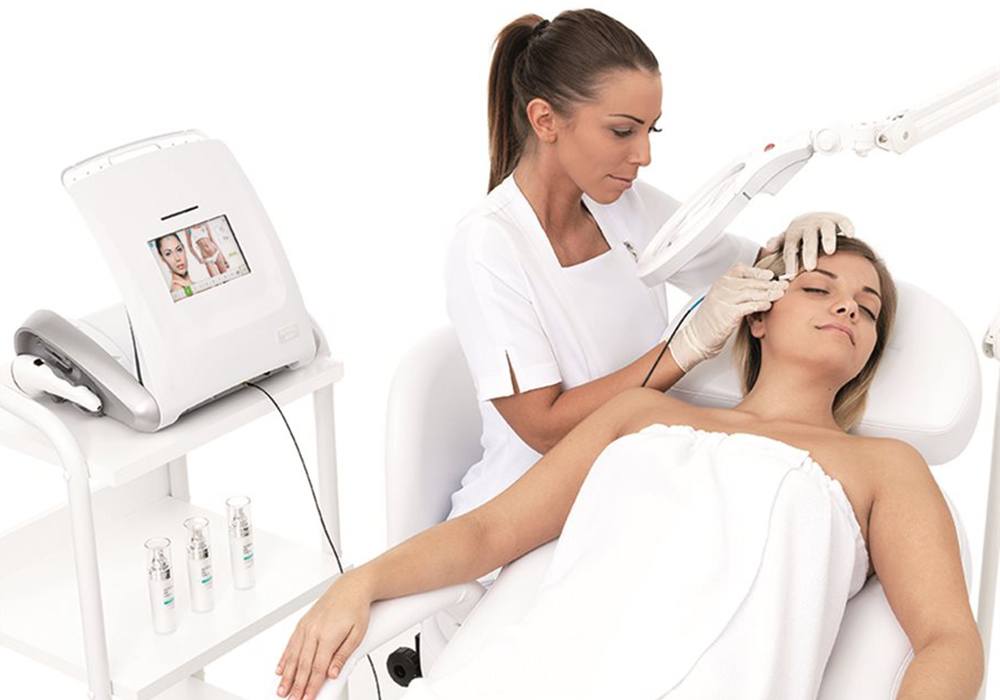
For 140 years, electrolysis has been and remains the only recognised method of 100% permanent hair removal. Electrolysis permanently destroys the cells responsible for hair growth by way of insertion of a fine probe in the hair follicle and the application of a current adjusted to each hair type and treatment area. Making it efficient, comfortable and safe for everyone.
The Apilus xCell offers an unmatched level of comfort in permanent hair removal with a state-of-the-art computerised electrolysis machine that limits the level of destruction within the hair follicle, targeting only the cells responsible for hair growth, this consequently protects the skin and prevents new hair growth. Just a few thousandths of a second will suffice to eliminate the hair, and makes the process virtually painless.
Owing to its powerful circuits and stable currents, Apilus offers pinpoint precision capabilities and optimal settings that deliver the results you seek. You can finally say goodbye to unwanted hair, whether it be facial hair or body hair.
Areas of Treatment include:
- All facial areas
- Legs
- Intimate Areas
- Chest, Back or Abdomen
- Nipples
- Underarms
- Fingers and Toes
- Eyebrows
Electrolysis Treatment Options:
Electrolysis Consultation
Our consultation process is to help prevent misconceptions about the treatment and its objectives, so it is very important to see each client as if they were having electrolysis for the first time and work through the process together. Our consultation will enable us to provide the most effective treatment to suit your needs. If you would like to receive the treatment on the same day as your consultation you are more than welcome to add the additional service to your consult.
Treatment Time
Electrolysis Treatment
We offer treatment times starting with 10 minutes and up to 3 hours. When booking online you are welcome to follow the orange ‘Book Online’ button or used the circular orange ‘Calendar’ icon on the bottom right of your screen.
The online booking platform is our live diary, once you have had your initial appointment with us you are welcome to book multiple sessions ahead of time to ensure availability. However we ask if you do this that you provide us with a minimum of 48 hours notice of cancellation so that we have the opportunity to fill any cancelled slots.
Treatment Times To
Types of Electrolysis
There are 3 traditional methods of electrolysis such as:
- Galvanic
- Thermolysis (is also called diathermy or RF diathermy in some countries).
- The Blend
The Apilus XCell Pro offers on top of the renowned Apilus treatment modes like PicoFlash, Synchro and EvoluBlend, it also offers additional methods of hair removal. Combined with programs specially optimised for men and women, these exclusive techniques will help achieve 100% permanent hair removal in record time!
PicoFlash
As a result of its exceptional speed, the PicoFlash thermolysis technique allows for a very localised and precise coagulation at the base of the hair follicle, while avoiding the diffusion of heat into the surrounding tissues. It offers targeted destruction of the cells responsible for the regrowth of all types of hair, all at a level of comfort.
Synchro (patented)
The Synchro method offers unequalled effectiveness in the removal of difficult and/or deep-rooted hair. Its simultaneous application of several picoimpulses, each lasting from 2 to 5 thousandths of a second, interspersed with a thermal relaxation period, allows for the intense destruction of all hair cells.
Syncroblend
The SynchroBlend method applies a layered galvanic current of several pico-impulses, interspersed with a thermal relaxation period. Designed for coarse distorted anagen hair.
EvoluBlend
The EvoluBlend method is characterised by the progressively intensified application of a galvanic current, starting at an intensity of 0 mA, and increasing to your tolerance level. A thermolysis current of 27.12 MHz is applied simultaneously, ensuring an effective and comfortable treatment on even the most difficult hair.
MeloFlash
MeloFlash is a thermolysis method conducted in hundredths of a second. Since the impulse time is longer and the intensity more gentle, the heat produced is dispersed more widely within the follicle. This technique is the ideal solution for strong, deep, or dehydrated hair.
MultiPlex
The MultiPlex technique combines slow thermolysis with an ultrarapid PicoFlash pulse. The slow thermolysis creates slight warming of the follicle, enhancing its porosity, and thus the effectiveness of the PicoFlash pulse. It allows for an intense destruction ideal for difficult or slightly deformed hairs.
Pre Electrolysis Treatment
Your treatment will be carried out by Salon Director Jen Turner. She holds a Level 5 Advanced Electrolysis qualification and has been providing electrolysis to men and women for over 15 years, you are welcome to ask her as many questions as you like.
Prior to your treatment you will be sent a consultation/medical profile and on the day of your treatment Jen will create you a client profile within our Apilus xCell Pro machine, here she will go through your medical profile and confirm any current medical conditions along with checking which method of treatment will be best suited to you. The method decided will depend on your skin type, hair type and your levels of hydration, a few short tests may be carried out on your initial treatment to deem what would be best suited (don’t worry these tests aren’t painful).
All the information stored is password protected and will also be remembered by the system so that each treatment is personalised to just you.
Contraindications to Treatment
General contraindications
– Epilepsy and seizures
– The first 3 months of pregnancy
– Cancer, radiotherapy, chemotherapy and remission (after 1 year without treamtnet and medication we would require a letter from your oncologist)
– Hepatitis, AIDS and HIV
– Hemophilia
– Treatment with Accutane (please wait 6 months from your last treatment)
– Puberty (wait one year after the onset of menstruation and we will require a parental signature under 18 years old)
– Multiple Sclerosis (medical note will be require and we can only offer thermolysis)
– Type 1 diabetes
– Cochlear implant
– Pacemaker (medical note required)
Local Contraindications (area being treated)
– If your pregnant we will avoid breasts and abdomen
– Phlebitis and thrombophlebitis
– Infection, disease and localised dermatitis (mycosis, warts, cysts etc)
– Hairy Nevi (we would require a medical note)
– Trunk varicose veins
– Eyelashes
– Inside the ear
– Inside the nostrils
– Erythema (inflammation, sunburn)
– Oral or genital herpes (with antivirals, Valtrex, Zantrex)
– Local pain and neuralgia
General Contraindications to direct current
– Paralysis
– Pregnancy
– Multiple Sclerosis
– Pacemaker
– Epilepsy
– Cancer
Local Contraindications to direct current (area being treated)
– Metal inclusion (coil, piercing, etc)
– Orthodontic treatment (braces, lingual wire retainers, dental implants, bridges and partials)
– Thyroid gland disorder
– Saline implants
– Contact lenses
– Local paralysis
Precautions
– No problem for type 2 diabetes (with doctors note)
– Botox injections etc (wait 15 days)
– Hearing aid (turn off)
– Allergies
Post Electrolysis Treatment
The first sign that your electrolysis treatment is working is that the hair growth will become softer, finer and lighter in colour. You will see and feel the difference throughout the course of treatment, so you do not have to wait until the end of your course to notice the change.
Our aftercare instructions do need to followed to support your electrolysis treatment.
There may be some hair growth between treatments. If the appointment is not within the next few days we advise to contact us to arrange bringing your appointments closer together. If you are unable to attend an appointment and you have hair growth you may only trim the hairs. This will clear the hair temporarily without interfering with the root of the hair and affecting results. Tweezing, threading and waxing must be avoided during a course of electrolysis.
Aftercare advice recommended for the 48 hours following treatment include:
- Avoid make-up (use Apres Cream as an alternative)
- Avoid soap and perfumed products
- Avoid sunbathing
- Avoid picking or touching the area
- Avoid swimming, steam rooms and saunas
- Avoid further heat treatments to the immediate area
- Wash hands and apply aftercare product to the area using fresh cotton wool
- Avoid all temporary methods of hair removal except trimming
- Keep up with appointments to obtain desired results
FAQs
How does electrolysis work?
Electrolysis works by disrupting the hair growth. The process works by inserting a fine probe into the skin, then using shortwave radio or direct current in the hair follicles it cauterises the blood supply to stop new hair from growing.
There are three types of electrolysis: galvanic (which chemically dissolves the follicle by the production of lye), thermolysis (which uses localised heat), and blend (which utilises both methods). Electrolysis is the only recognised form of permanent hair removal — but it’s important to note that it can take time. Hair grows in a cycle of stages: growing (anagen), resting (catagen) and shedding (telogen). Because each hair follicle isn’t on the same stage at any given time, multiple sessions will be required.
Can I have electrolysis if I am pregnant?
Yes, as pregnancy is not normally a contra-indication to the Thermolysis/Shortwave diathermy method of electrolysis. This method uses alternating current (AC) which produces a very weak intensity of current during the procedure. There is no risk to mother or unborn child although treatment of the breast and abdominal areas should be avoided, especially in the later stages of pregnancy – this is entirely due to the fact that the skin in these areas is stretched and therefore under duress – no harm could be caused to the foetus as the current does not pass through the body at all.
However, the ‘Blend’ or ‘Galvanic’ methods of electrolysis is best avoided during pregnancy. These methods use direct (DC) electrical current. If you are unsure which method you may be offered, please ask your electrolysist.
If, by chance, you have been having ‘Blend’, please do not worry, it too can be used during pregnancy and should not pose any problem, especially if treatment has been to the facial area. Many clients have treatment before they know that they are pregnant, without any ill effects whatsoever. If you are at all concerned, please discuss this issue with your therapist/practitioner or GP. (Please note some members may choose not to offer treatment during pregnancy.)
What conditions would prevent me from having an electrolysis treatment?
The following would contra-indicate electrolysis until the condition is cleared:
- Recent scar tissue in the area to be treated ( leave 6 months to a year depending on the size and depth of the wound)
- Sunburn in the area to be treated.
- Severe Dermatitis / Eczema (whilst open and sore)
- Any unidentifiable skin condition
Electrolysis on the following may be restricted but for your own peace of mind it may be worth visiting your GP to check that you are ok to proceed:
- Asthma – Is your asthma is medically controlled? inhalers are normally steroid-based which can have an influence on hair growth.
- Diabetes if insulin dependent we will need GP referral if controlled by diet skins healing rate will be slower
- Epilepsy
- Hyper/Hypopigmentation problems.
- Hiatus hernia (positioning)
- High blood pressure (where under medical supervision)
- Metal Plates & Pins can restrict the treatment. This will depend upon the size and location of the metal.
Contra-indications can prevent treatment or require your GPs approval. Should you be unsure of a particular condition or medication then its always best to seek a Doctor’s referral letter prior to treatment.
- Moles – We are able to treat hairs coming from moles but we will require a GP’s consent letter.
- Age – Any client under the age of 16 must have their parents or guardians consent. We will also require that the parent or guardian is present for all treatments.
- Anxiety/ stress (when severe).
- Areas where there is a loss of tactile sensation.
- Blood disorders e.g. haemophilia, AIDS HIV. Hepatitis and HIV are both serious viruses transported by the blood. Due to the risks of cross-infection unfortunately the treatment is not permitted.
- Cancer current or history of is contra-indicated unless you have written permission from your GP.
- Cardiovascular disorders, circulatory disorder anticoagulant drugs, prescribed for these conditions, interfere with the effectiveness of the treatment and can cause clotting problems, varicose veins when working in the area
- Diabetes Diabetic clients may have a poor healing rate with little sensation in their skin the symptoms can either be controlled by diet and or medication. There are different types of diabetes and treatment can commence with a Doctor’s letter. If the treatment is permitted then it may be necessary to space out the treatments.
- Endocrine disorder/ hormone imbalance
- Electronic devices eg Pacemaker/defibrillator and auditory devices implant Pacemakers/ defibrillator are devices implanted to maintain a normal heart rate. The use of an electrical current can cause interference and the outcome could be fatal.
- Emphysema is a long-term, progressive disease of the lungs and occurs when the alveolar walls are destroyed along with the capillary blood vessels that run within them. This lessens the total area within the lung where blood and air can come together, limiting the potential for oxygen and carbon dioxide transfer.
- Infections
- Viral infections e.g. Herpes Simplex or Warts in the area.
- Bacterial infections e.g. Impetigo highly contagious Acne Vulgaris.
- Fungal Infections e.g. Ringworm highly contagious.
- Parasitic infections e.g. Scabies highly contagious.
- Immune system. Normally the immune system protects the body from infection. In lupus, however, the immune system inappropriately attacks tissues in various parts of the body. This abnormal activity leads to tissue damage and illness
- Keloid scarring
- Medication certain medications can restrict electrolysis. A Doctor’s letter is required, as electrologists will not be knowledgeable enough about certain medications to make the decision.
- Metal plates and pins when using direct current, in particular, the current will earth itself at the nearest piece of metal. SWD method of electrolysis is also a contra-indication if in the immediate vicinity.
- Pregnancy ie the first trimester when the viability of the foetus is questionable. We also not perform Blend or Galvanic methods below the neck area during pregnancy.
- Psoriasis is an autoimmune disease that appears on the skin. It occurs when the immune system mistakes the skin cells as a pathogen and sends out faulty signals that speed up the growth cycle of skin cells.
- Skin conditions: If you suffer from facial erythema, eczema, dermatitis, sunburn, cuts abrasions, recent wounds, bruising, oedema, treatment may be prevented or restricted.